Revitalised Maritime Trading Routes and The ‘Ingot God’ of Enkomi
Uncovered in 1963 beneath the ash and beaten-earth floors of a 12th-century BCE sanctuary at Enkomi (modern day Famagusta), the famous "Ingot God" statuette presents a fascinating chronological and technological paradox (Courtois, 1971). While Enkomi’s smiths were increasingly forced to forge utilitarian iron tools to survive the era's severe tin shortages, this thirty-five-centimetre bronze deity stands proudly atop a thirty-kilogram copper oxhide ingot (Knapp, 1986). This apparent contradiction is resolved by understanding the dual economy of post-collapse Cyprus. Iron became the gritty metal of practical survival, but raw copper remained the foundational currency of elite wealth and international cabotage trade. Many archaeologists suggest the statuette was actually cast prior to the regional collapse and carefully curated as a sacred heirloom, a nostalgic, divine anchor to the golden age of imperial trade (Webb, 1999).
Regardless of its exact casting date, the Ingot God’s presence in a post-collapse sanctuary reveals how Cypriot elites managed the crisis. As the old Mycenaean and Hittite trade monopolies dissolved, the local commercial oligarchies of Enkomi needed to maintain control over a rapidly changing, multi-ethnic workforce of migrant craftspeople (Kassianidou, 2005). By venerating a martial deity physically fused with a copper ingot, the elites sanctified the island's primary economic resource. Even as practical iron knives replaced degrading bronze in the fields, the copper ingot remained the ideological symbol of Cypriot resilience, reassuring the populace that their metallurgical heritage would endure the collapse of the Bronze Age world.
The Atlantic Tin Trickle: Too Little, Too Late
As Cypriot merchants expanded their cabotage networks westward to Sardinia, they successfully tapped into the Atlantic Bronze Age pipeline. Through Sardinian middlemen, a trickle of tin from Brittany (modern day France) and Cornwall (modern day United Kingdom) began to flow back east into the Mediterranean, replacing the severed overland routes from Central Asia (Stos-Gale, 2011). Isotopic analysis of late-era ingots found in the Levant confirms that Western European tin did indeed reach the eastern shores. However, for the general economy of the Eastern Mediterranean, this western tin arrived too little, too late.
By the time this new supply chain was established, the pyrotechnological genie was already out of the bottle. Cypriot and Aegean smiths had already mastered the higher-temperature furnaces required to forge utilitarian iron. Because iron ore was abundant and locally available across the eastern mainland and islands, it freed societies from the geopolitical vulnerability of long-distance metal imports. The new influx of western tin allowed the Cypriots to resume casting luxury bronze items, such as the elaborate tripod stands and religious heirlooms revered by the elites, but it could not reverse the broader industrial revolution (Muhly, 2003). The technological threshold had been crossed. Iron was too practical, too abundant, and too strategically secure to abandon, cementing the Eastern Mediterranean's transition into the Iron Age.
Wider Connections to Sardinia
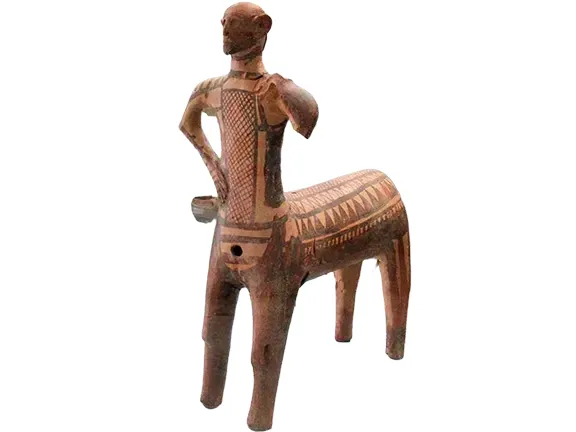
The striking resemblance between the Enkomi Ingot God and the Nuragic bronzetti (small bronze warrior figurines from Sardinia) is a major topic of discussion among Mediterranean archaeologists. Scholars frequently describe the stylistic parallels, such as the horned helmets, martial postures with raised weapons, and the use of greaves, as an "uncanny resemblance" that points to deep ideological and material connections across the Mediterranean during the Final Bronze Age.
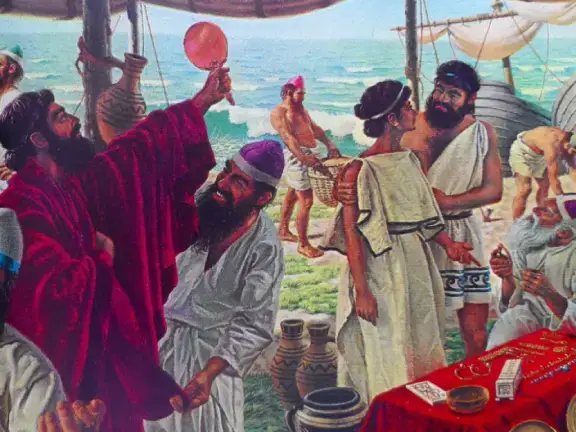
This stylistic overlap was not a coincidence; it was carried on the backs of merchant ships. Prior to the collapse, Cyprus was exporting massive quantities of copper directly to Sardinia. Fragments of Cypriot oxhide ingots, the same shape as the one the Enkomi deity stands upon, have been found scattered across Nuragic sanctuaries and hoards. Along with this raw metal, Cypriot merchants seemingly exported their metallurgical iconography. The Sardinian elites, who were developing their own bronze-working traditions, readily adopted and localized this eastern imagery, resulting in the famous Nuragic warrior statuettes.
The earliest bronzetti date to the 12th century BCE. Their manufacture continued on Sardinia until the 9th or 8th centuries BCE. Unlike the eastern Mediterranean, the tin supplies to Sardinia, from Brittany and Cornwall had not been disrupted by the collapse of the empires in the east.
Anthropologists note a fascinating difference in how these symbols were used. In Cyprus, as embodied by the Ingot God, copper ingots were associated with the exclusive, elite control of the metallurgical industry (Blake, 2014). In Sardinia, the Cypriot ingots and the resulting bronzetti circulated much more fluidly through regional networks. Nuragic society lacked the centralised palaces of the East; instead, these figurines were deposited as votive offerings at communal holy wells and sanctuaries, reinforcing social cohesion rather than oligarchic dominance. Thus, while the visual style of the Ingot God travelled west, its political meaning was entirely adapted to fit Sardinian society.